
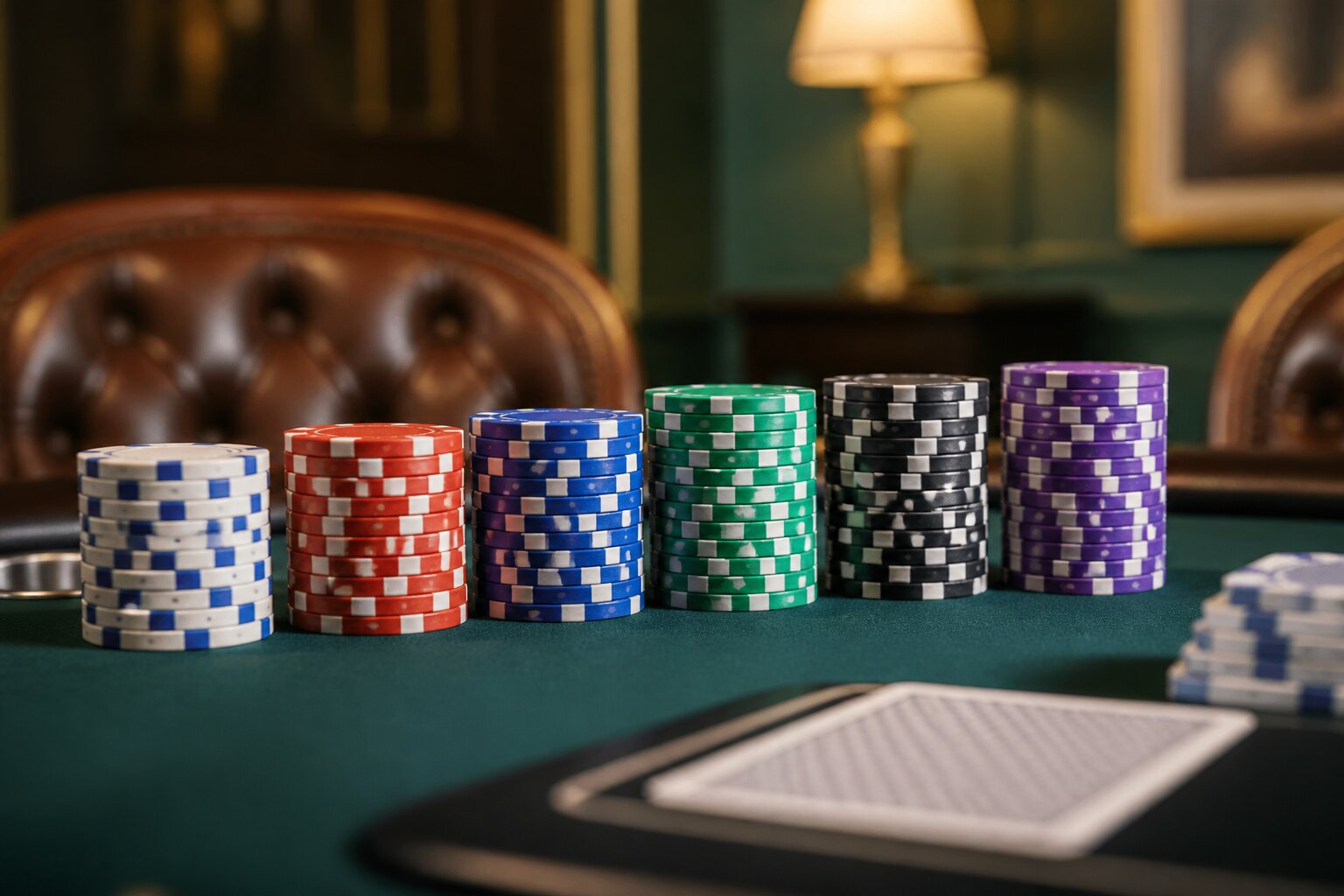
Ever sat down at a poker table and wondered what all those colourful chips actually mean? You’re not alone. Knowing chip values and their colours keeps the game moving and helps everyone make accurate bets without awkward pauses.
This guide explains the usual colour schemes, how values are assigned in different settings, and practical tips for looking after your chips. Read on to make your next game smoother and more enjoyable.
What Do Poker Chip Colours Mean?
Chip colours give a quick, visual way to identify value during play. When a set follows a consistent scheme, players can place bets and count stacks without constant clarification.
Commonly, white chips represent the lowest value, followed by red and green, with black, purple or blue used for higher denominations. While exact values vary between home games and different venues, the underlying idea stays the same: a colour equals a value, making the table easier to read at a glance.
If you join a new game, a short reminder of the agreed values avoids confusion. That small habit keeps the action flowing and prevents disputes over what a particular colour stands for.
Common Poker Chip Denominations Explained
Below are the denominations most often used, though remember these can be adapted to suit the stakes and number of players.
- White chips: Most commonly valued at £1.
- Red chips: Often used for £5.
- Blue chips: Sometimes used for £10.
- Green chips: Usually represent £25.
- Black chips: Commonly stand for £100.
- Purple chips: Seen in larger games, often marking £500.
These standard values make it easier to follow the betting structure and speed up play. Clear, consistent denominations help players count stacks quickly and reduce disputes over chip value.
If a set includes printed or embossed markings for denominations, that extra clarity further reduces the need for constant checking and keeps the game steady. Tournament organisers and home hosts often adjust colours or values to match buy ins, blind levels and pace of play, so agree the system before you start.
Play responsibly and ensure stakes are suitable for everyone taking part.
Why Are Poker Chip Colours Standardised?
Standard colours reduce mistakes and speed up play. When everybody recognises the same colour-value relationship, there's less need to confirm bets and more focus on the game itself.
A shared system also cuts down on disputes. If a disagreement does arise, the established colour scheme provides an immediate reference point for resolving it. Beyond organisation, this consistency supports fair play and helps create a predictable environment for all players.
Knowing the usual standards makes it easier to join different groups or events without a learning curve. That familiarity is handy whether you’re at someone’s home or a larger gathering.
How Are Poker Chip Values Assigned in Home Games?
At home, values are usually agreed by the group before play begins. Players choose a scheme based on the chips they have and the stakes they want to play for, often sticking to the common denominations listed earlier or adapting them slightly.
It helps to communicate the system clearly — a written note or a quick verbal recap at the table is enough. Doing so prevents mid-game confusion when chips change hands and ensures everyone understands the relative worth of each colour.
Groups should also pick stakes that suit all players. If anyone feels uncomfortable with the amounts involved, it’s perfectly acceptable to lower the stakes or step away. Keeping the experience enjoyable for everyone is the priority.
Choosing the Right Poker Chips for Your Game
Selecting chips involves balancing practicality, appearance and budget. A set with a clear range of colours and enough units for each player will make betting rounds run smoothly and reduce the need to swap chips mid-game.
Marked denominations on chips can be useful, especially for casual or mixed-experience groups. Material matters too: clay-composite chips feel different to plastic ones and tend to stack and shuffle more easily, but they often cost more. Consider how often you’ll use the set and how many players you’ll usually host.
There’s no need to overspend; many affordable sets are perfectly serviceable. Think about storage and portability as well — a sturdy case keeps chips organised and protects them between games.
Customising Poker Chip Colours and Values
Custom colours or labels can make a set feel personal and help prevent mix-ups if you play at different venues. When values are customised, it’s important to explain them once before play starts so everyone is on the same page.
Customisation is most useful for recurring groups that want a particular look or for themed events. Keep the changes simple so they don’t add needless complexity to the game.
Myths About Poker Chip Colours and Values
There are a few misconceptions that crop up around poker chip colours and values.
Common misunderstandings include:
- The idea that colours are fixed everywhere. In reality, there is no single global standard; many home games, clubs and casinos adapt values to suit their stakes and preferences.
- The belief that chip colour affects outcomes. Colour is simply a visual marker of value and has no influence on how the game plays out.
- The thought that fancier or heavier chips must be worth more. Design and weight reflect quality, not necessarily denomination.
Custom sets are fine, provided everyone is informed about the value system before play begins. The key point is clarity: once everyone understands whether the scheme is standard or bespoke, the chips serve their purpose efficiently.
To avoid confusion, agree blind and buy-in structures in advance, use clearly marked chips where possible, and make sure all players have the same information. This keeps play fair and straightforward for everyone involved.
Caring for and Storing Your Poker Chips
Basic care keeps chips looking and performing well over time. Wiping them with a soft, damp cloth removes surface dirt; harsh cleaners should be avoided because they can damage the finish or markings. If you need extra cleaning power, use a mild, pH-neutral soap diluted in water, and test on a single chip first. Always rinse away any soap residue and dry chips fully before returning them to their case.
Avoid soaking chips or using abrasive pads, solvents, bleach, or alcohol-based products, as these can fade colours or lift printed details. If a chip has stubborn grime, gently rub it rather than scrubbing hard.
Store chips in a cool, dry place inside a protective case to prevent dust build-up and accidental damage. Keep them out of direct sunlight and away from sources of heat or humidity, which can warp materials or alter colours over time. Simple, robust cases are usually the best option; there is no need for elaborate solutions.
Treating your chips with straightforward care extends their life and maintains the clarity of the colour-coding you rely on at the table. Regular, gentle maintenance not only preserves appearance but also helps chips feel consistent during play.
Frequently Asked Questions About Poker Chip Values and Colours
Here are answers to common questions players ask when putting together a set or joining a new game.
Can I use any colours for poker chips in my home game?
Yes. Any colours will work so long as all players agree on the values beforehand. A brief reminder at the start of the session keeps everyone aligned.
Do I need to buy expensive chips for a quality game?
No. Affordable sets are often perfectly suitable. Focus on getting a clear range of colours and enough chips rather than premium materials, unless you expect heavy, frequent use.
How do I clean my poker chips?
A gentle wipe with a damp cloth is usually sufficient. Avoid chemicals and make sure chips are completely dry before storing them.
Are certain chip colours more valuable?
Colours themselves have no inherent value; their worth comes from the values you assign for that session. Clear communication about those assignments is what matters.
Keeping chip values transparent and looking after your set will help your games run smoothly and fairly for everyone involved.
**The information provided in this blog is intended for educational purposes and should not be construed as betting advice or a guarantee of success. Always gamble responsibly.