
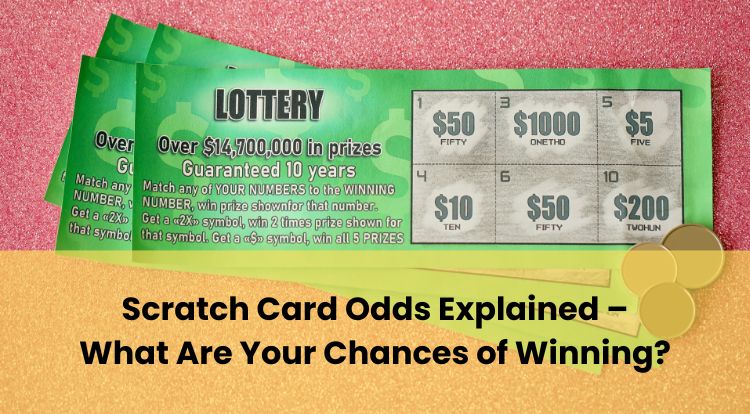
Ever picked up a scratch card and wondered what the real likelihood is of winning a prize? You’re definitely not alone. Scratch cards look straightforward, but the numbers on the back can be easy to misread.
You might have seen bold claims on a ticket or heard about a big win at the newsagent’s. What do those figures actually say about your chances?
This guide breaks down how odds are set, how prizes are distributed, and what terms like “odds per game” or “odds per pack” really mean. By the end, you’ll read that small silver panel with much more confidence.
What Do Scratch Card Odds Mean?
When you look at a scratch card, you’ll often see a statement like “1 in 4 wins a prize.” This gives a broad indication of how many cards, across the full print run of that game, contain any prize at all.
In the UK, these odds are worked out by dividing the total number of scratch cards made for a game by the number of winning cards included. If there are four million cards printed and one million of them win something, the odds are 1 in 4.
Those odds do not guarantee a result within a set number of purchases. Each card is independent, so outcomes are not influenced by what happened on the last one. You could win on your first card, or you might buy several without a return.
It is also worth noting that this figure usually refers to winning any prize, not necessarily the top one. Many prizes are small, sometimes equal to the ticket price, while the larger amounts are much less common.
Understanding that headline figure makes it far easier to read the detail on each game, which is where the next part comes in.
How To Read The Odds On A Scratch Card
Most scratch cards include a section in small print showing the odds. In the UK, these are typically displayed as “1 in X,” such as “1 in 4” or “1 in 3.75.” That means that, across the entire production run, one card in that number is expected to be a winner.
You will usually find this on the reverse of the card, on the packaging, or on the game’s page online. The wording often clarifies that the figure relates to any prize, which, as mentioned earlier, can range from a money-back amount to a much higher tier. Separate odds for top or mid-tier prizes may also be listed.
You might see references to “odds per pack.” This is about the expected number of winning cards in a sealed pack, which tends to contain a fixed quantity, for example 60 or 100 cards.
If anything is unclear, the official game page sets out the rules and odds in full. So where do those figures come from in the first place? They are set when the game is designed.
How Are Odds Calculated For Each Prize Tier?
Every scratch card game has prizes split into tiers, from the smallest cash amounts through to the top prize. The overall structure is decided before printing starts, including how many cards will be made and how many prizes of each type will exist. Odds for each tier are then calculated by comparing the number of winning cards at that tier to the total number of cards printed.
Step By Step Example Of Calculating Odds
Let’s say a scratch card game launches with 2,000,000 cards in total. Out of those, there are:
- 4 cards with a £100,000 prize
- 2,000 cards with a £100 prize
- 100,000 cards with a £5 prize
For the £100,000 prize, 2,000,000 divided by 4 gives odds of 1 in 500,000 for finding a card with the top prize.
For the £100 prize, 2,000,000 divided by 2,000 gives odds of 1 in 1,000.
For the £5 tier, 2,000,000 divided by 100,000 gives odds of 1 in 20.
The same approach is repeated for every prize tier, and the figures are published with the game details. That way, you can see how the structure balances frequent small wins with much rarer larger payouts.
Does Prize Distribution Matter For Your Chances
Prize distribution explains how prizes are spread across the entire print run. A single game might include only a few top prizes but thousands of smaller ones. That is why the overall “any prize” odds can look reasonable, while the odds for a top tier remain long.
Once a game launches, the number of prizes in each tier is fixed and the cards are mixed before being sent to retailers and online sellers. As time passes and players claim prizes, some of the biggest wins may already have been taken, even though remaining tickets are still on sale.
Many official sites show the number of unclaimed prizes for active games. This does not change the printed odds, which were set at launch, but it does tell you what is still available at that point in time. If a top prize has already been claimed in full, the practical chance of finding another top-prize card in that specific game is no longer there.
With that in mind, format is another factor people often ask about.
Are Retail And Online Scratch Card Odds Different?
In shops, scratch cards are printed in batches with prizes predetermined and shuffled through the packs. Online, many digital scratch games use Random Number Generation, a system that ensures each play is independent and measured against the game’s published odds rather than a physical batch.
Both formats have their odds and payout structures checked for fairness by the regulator. The figures are clearly listed in the game rules. One is not automatically better than the other, but individual games can vary in how their prize tables are set up.
If you want to know the specifics for a particular game, the product page and rules provide the most reliable snapshot.
How To Compare Odds Between Different Scratch Cards
With all that in mind, comparing games becomes more straightforward. The simplest reference point is the stated odds for any prize, shown as “1 in X.” That tells you how frequently the game pays out at all, though, as discussed earlier, it includes small amounts.
If you care more about higher-value wins, look at the odds for top and mid-tier prizes rather than only the headline figure. Prize tables help here, because they show how many prizes exist at each level. You may find one game offers frequent small returns, while another concentrates more of its budget into fewer, larger awards.
Price can also play a part. Higher-priced cards sometimes offer stronger odds for mid-tier prizes or include larger top prizes, while lower-priced cards can focus on more modest wins. Online games may also publish a return to player percentage, which describes the long-term proportion of stakes that goes back to players across all outcomes.
We keep our odds pages updated so you can compare prize tables and key figures side by side before you choose. If you prefer to browse directly, check the game’s official page for the latest prize breakdown and remaining prize information.
If you ever feel your play is getting out of control, free and confidential help is available from organisations such as GamCare and GambleAware.
**The information provided in this blog is intended for educational purposes and should not be construed as betting advice or a guarantee of success. Always gamble responsibly.